 Eden & Dane
Native Red Mulberry
The mulberry that belongs here. A Virginia native with sweet, dark fruit in early summer, grown at our own nursery in Great Falls.
Red mulberry asks for very little. Once established it needs no spray program, only light pruning, and it grows in a wide range of soils, including the heavy clay common across Northern Virginia. It is one of the few fruit trees that genuinely tolerates partial shade, because in the wild it grows as an understory and edge tree along streams and woodland margins.
The fruit ripens over several weeks in early summer, and you will share it. Songbirds find red mulberry almost immediately, which is part of why it earns a place on the property: it feeds wildlife that might otherwise go for your other fruit.
Before you plant.
Planting & Growing Information
Good company
for your mulberry tree.
A Virginia native
the birds already know.
Red mulberry is the mulberry that belongs here. It grows wild along stream banks and woodland edges from southern New England to Florida, and it is one of the first fruits of the season for dozens of songbird species.
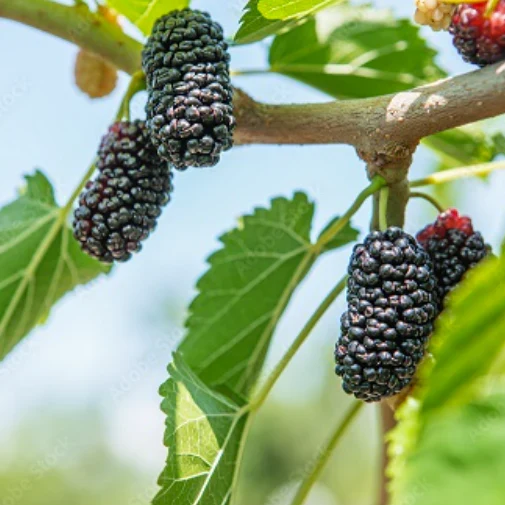
The berries are dark purple to nearly black when ripe, sweet with a little tartness, and they ripen over several weeks in early summer. Once established the tree needs no spray program and little pruning, and it tolerates partial shade better than most fruit trees.
It is also worth planting for its own sake. The native red mulberry is losing ground to the Asian white mulberry, which hybridizes with it freely. Planting true Morus rubra from our own nursery keeps the native tree in the landscape.
- Native red mulberryMorus rubra, grown at our nursery in Great Falls.
- Wildlife and edge plantingsA strong choice for hedgerows, stream buffers and the woodland edge.
- Food forest canopyA mid-sized fruiting tree for the upper layer of a food forest.
- Current stockInventory varies by season and batch. Contact us to confirm what is available now, and in what size.
What to know before you buy
Mulberries drop ripe fruit steadily. Do not plant over patios, driveways or cars.
Red mulberry trees are usually either male or female, and only females bear fruit. Ask us about the plants in the current batch before you buy.
It grows into a tree of roughly 35 to 50 feet. Give it room, or plan to prune it to keep the fruit in reach.
Prune lightly in winter. Mulberries bleed sap if cut in spring.
What we ship.
Plants ship in the dormant seasons, late fall and early spring, with local pickup in Great Falls. Availability changes by batch, so ask if you need a particular size.
Planting at scale.
We supply landscapers, nurseries, farms and larger residential projects with native red mulberry in quantity. Stock is seasonal and limited, so get in touch ahead of your planting window and we will plan around your order.
Ask about wholesale →
Planning an orchard, guild or garden around this plant? An on-site consult in the DC area starts at $250, a written Remote Strategy at $1,500, or start small with a free guide.